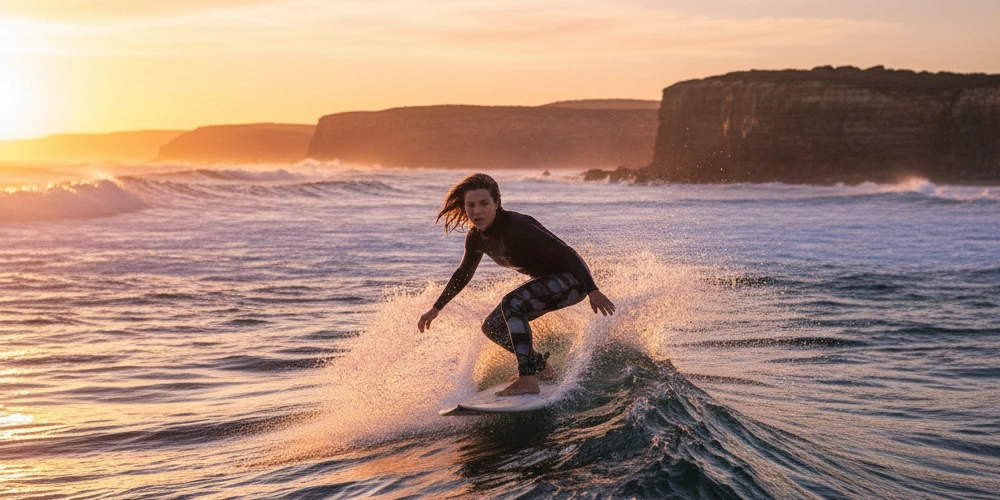
Australian women have been absolutely charging in surfing lately. World titles, Olympic medals, groundbreaking performances – it’s been an incredible era. But the story of women’s surfing in Australia goes way deeper than the current crop of superstars tearing up the Championship Tour.
It’s a story of pioneers who pushed boundaries when the sport barely acknowledged women existed. Of athletes who fought for equal prize money and respect. Of generations building on what came before, each one opening doors wider for the next.
Let’s dive into how Australian women went from afterthoughts in the lineup to dominating the world stage.
The Early Days: When Women Weren’t Supposed to Surf
Back in the early 1900s, surfing was barely a thing in Australia, and women participating in it? That was practically scandalous. Society had pretty firm ideas about what women should and shouldn’t do, and riding waves in the ocean definitely fell into the “shouldn’t” category.
But some women didn’t care what society thought.
Isabel Letham was one of the first. In 1915, she surfed tandem with Hawaiian legend Duke Kahanamoku at Freshwater Beach in Sydney. At a time when most women wouldn’t even wear a swimming costume that showed their legs, Letham was riding waves. She became a surf instructor and lifeguard, proving that women could handle the ocean just as well as men.
For decades after that, women’s surfing existed in the margins. A few dedicated souls kept at it, but competitions were rare, recognition was minimal, and the idea of women as serious surfers was treated more as a novelty than a legitimate pursuit.
The 1960s: Breaking Through
The 1960s brought real change. Surfing was exploding in popularity, the counterculture movement was challenging traditional norms, and women started demanding their place in the lineup.
Phyllis O’Donnell was the breakthrough star. She won the first-ever ISA World Championship for women in 1964, then backed it up with three straight Australian titles from 1963 to 1965. The Australian Surfing Awards recognize O’Donnell as a dominant force who helped put Australian women’s surfing on the world stage when the sport was still figuring itself out.
Around the same time, Gail Couper was establishing herself as a force of nature. She’d go on to win the Bells Beach women’s event ten times – a record that will probably never be broken. Ten times. That’s not just good; that’s legendary.
These women weren’t just competing – they were proving that women belonged in serious surf competitions, that they could handle powerful waves, and that they deserved to be taken seriously as athletes.
The 1980s and 1990s: Fighting for Equality
By the ’80s and ’90s, women’s competitive surfing was established, but it was far from equal. Prize money was a fraction of what the men earned. Events got cancelled last minute. Media coverage was minimal unless you looked good in a bikini.
Enter Pam Burridge.
Burridge was an incredible surfer – multiple Australian and world titles – but her biggest impact might have been off the water. She was vocal, relentless, and refused to accept the status quo. She pushed for equal prize money, better event scheduling, and genuine respect for women’s surfing. She used her media profile to shine a light on the inequalities and kept the pressure on.
It wasn’t easy, and progress was slow, but Burridge and others like her laid the groundwork for everything that came after.
Wendy Botha, though originally from South Africa, became an Australian citizen and dominated the late ’80s and early ’90s with four world titles. She brought a powerful, aggressive style that showed women could surf just as radically as men.
Pauline Menczer, coming from a working-class background, fought her way to a world title in 1993 despite never fitting the marketable image that sponsors wanted. Her story highlighted how women surfers were judged on looks as much as performance – a battle that continues, though it’s gotten better.
The 2000s: The Layne Beachley Era
Then came Layne Beachley, and everything changed.
Beachley didn’t just win world titles – she absolutely dominated. Seven world championships, including six in a row from 1998 to 2003. That streak might be the most dominant run in professional surfing history, men’s or women’s.
But Beachley’s impact went beyond her competitive achievements. She was fierce about equality, using her platform to demand better for women’s surfing. Better prize money, better event venues, better coverage. Surfing Australia honored Beachley with Life Membership in 2024, recognizing not just her seven world titles but her tireless advocacy for women’s surfing and her role in championing pay equity and greater opportunities.
After retiring from competition, she became Chair of Surfing Australia and continued pushing for progress. The improvements in women’s surfing over the past decade owe a massive debt to Beachley’s refusal to accept anything less than equality.
The Modern Era: Stephanie Gilmore and the Golden Generation
If Beachley opened the door, Stephanie Gilmore walked through it with style.
Gilmore won her first world title in 2007 as a rookie – something that had never been done before. She made it look easy, too, surfing with this effortless, flowing style that made everyone else look like they were trying too hard.
She went on to win six more world titles (so far), tying Beachley’s Australian record. But Gilmore’s influence goes beyond the trophy count. She brought style and grace back to women’s surfing at a time when it was moving toward pure power and aggression. She proved you could surf beautifully and win world titles.
Gilmore also showed that women surfers could be genuine global superstars. She landed major sponsorships, appeared in mainstream media, and became one of the most recognizable faces in surfing – male or female.
The Current Charge: Tyler Wright, Sally Fitzgibbons, and the Next Generation
Tyler Wright burst onto the scene as a teenager and has never stopped pushing. Two world titles (2016 and 2017) and a reputation for fearless surfing in heavy conditions. Wright’s also been vocal about mental health, LGBTQ+ rights, and other social issues, using surfing as a platform for change.
Sally Fitzgibbons represents consistency at the highest level. Multiple world title runner-up finishes, countless event wins, and a work ethic that’s legendary. She’s competed at the Olympics, won at the biggest venues, and shown that longevity at the top level is possible with the right approach.
And now there’s Molly Picklum, who in 2025 claimed her first world championship title after an incredible season. Her backhand barrel riding is some of the best in the world, and she represents the next generation of Australian women dominating at the highest level.
The depth of Australian women’s surfing right now is insane. Isabella Nichols, Macy Callaghan, Willow Hardy – there’s a lineup of young women coming through who can all rip.
The Fight for Equal Pay: Finally Won
For decades, women’s surfing prize money was embarrassingly lower than men’s. We’re talking about women getting 30-50% of what men earned for winning the same events. The justification was always the same: fewer sponsors, less media coverage, smaller crowds.
But here’s the thing – it’s a circular argument. Women’s surfing had less commercial appeal partly because it was marketed less, given worse venues and time slots, and treated as secondary to men’s surfing.
The fight for equal pay took decades. Pioneers like Burridge and Beachley led the charge. The World Surf League finally announced equal prize money across all its events in 2018. They weren’t the first – some independent events had already done it – but as the sport’s major tour, it was huge.
Was it the WSL suddenly seeing the light? Partly. But mainly it was because women in surfing refused to shut up about it, kept pushing, kept demanding, and made it impossible to ignore the inequality any longer.
The Olympic Effect
Surfing’s inclusion in the Tokyo 2020 Olympics (held in 2021 because of COVID) was massive for the sport, and especially for women’s surfing. Suddenly, surf was in front of audiences who’d never watched it before, with equal billing and coverage for men and women.
Australian women have excelled at the Olympics. Sally Fitzgibbons competed in Tokyo, and the Olympic platform gave women’s surfing legitimacy in mainstream sports media in a way tour events never quite did.
The Olympics also brought funding. Government sports programs that support Olympic athletes suddenly had a reason to invest in surfing. Pathway programs, coaching, facilities – the infrastructure improved dramatically.
Beyond Competition: Free Surfing and Film
While competitive surfing gets most of the attention, there’s a whole world of women pushing boundaries outside the contest jersey.
Australian free surfers like Felicity Palmateer have built careers charging big waves and creating stunning surf content. They’ve shown there are multiple paths to success in surfing beyond the Championship Tour.
The rise of social media and surf film has created opportunities that didn’t exist before. Women can build followings, land sponsorships, and make careers without ever competing professionally. That’s opened doors for different kinds of surfers – big wave riders, barrel specialists, aerial innovators – who might not fit the traditional competitive mold.
Grassroots Growth: More Women in the Water
Walk to any Australian beach now and you’ll see way more women and girls surfing than you would have twenty years ago. Surf schools report that women make up a huge percentage of their students. Surf clubs have strong female membership. Women-only surf programs and retreats are everywhere.
Surfing Australia’s initiatives like the Hyundai She’s Electric program are actively working to support female surfers at the grassroots level, creating pathways and opportunities for the next generation.
Part of this growth is seeing representation at the top level. When girls can watch Australian women winning world titles and Olympic medals, they can picture themselves doing it too. Representation matters, and Australian women’s surfing has that now in spades.
The Challenges That Remain
For all the progress, challenges remain. Women still face:
Crowds and Localism: Some breaks remain pretty hostile to women, with heavy localism and entitled male surfers who think they own the spot.
Safety Concerns: Women surfing alone or in remote locations face different safety considerations than men do. It’s an unfortunate reality that limits access and opportunity.
Body Image Pressure: Despite progress, women surfers still face more scrutiny about their appearance than men do. The “surf babe” image persists in some marketing, even as the athletic achievements get more recognition.
Sponsorship Gaps: While equal prize money exists on the Championship Tour, sponsorship deals and endorsement money still tend to favor men, particularly outside the top tier.
Media Coverage: Women’s heats still sometimes get less favorable time slots, less coverage, and less analysis than men’s events, even at the same competitions.
The Future Looks Bright
Despite the remaining challenges, the trajectory is clear. Australian women’s surfing is stronger than it’s ever been and keeps getting better.
The talent pool is deep. The pathway programs are solid. The role models are there. And maybe most importantly, there’s a generation of young girls growing up who never knew a time when women’s surfing wasn’t respected, valuable, and successful.
They’re not fighting for a seat at the table – they’re already there, and they’re not going anywhere.
What We Can All Do
If you’re stoked about the rise of women’s surfing in Australia, here’s how to support it:
Watch women’s surfing. Stream the events, follow the athletes on social media, engage with the content. Views and engagement matter.
Call out inequality when you see it. If a surf event has unequal prize money or scheduling, say something. If someone’s being sexist in the lineup, don’t let it slide.
Support women-owned surf businesses and brands. There are incredible shapers, surf schools, and surf brands run by women. Give them your business.
Encourage young girls to surf. If you’ve got daughters, nieces, or young girls in your life, get them out in the water. Be the encouragement they need.
Respect women in the lineup. Don’t snake them, don’t underestimate them, and don’t act surprised when they rip. Just treat them like any other surfer – with respect.
The Pioneers Made This Possible
Every time Molly Picklum wins an event, every time a young girl catches her first wave at a surf school, every time a woman paddles out at a heavy reef break – they’re standing on the shoulders of the pioneers who came before.
Isabel Letham defying convention in 1915. Phyllis O’Donnell winning world titles in the ’60s. Pam Burridge fighting for equality in the ’90s. Layne Beachley dominating the 2000s. Stephanie Gilmore bringing style and grace. All of them, and hundreds more whose names aren’t in the history books, pushed boundaries and refused to accept limitations.
They faced skepticism, discrimination, and outright hostility. They fought for prize money, respect, and opportunities. They proved, over and over, that women could surf at the highest level.
And now, Australian women dominate world surfing. Not just competing – dominating. World champions, Olympic medalists, big wave riders, aerial innovators. The full spectrum.
The Story Continues
The rise of women’s surfing in Australia isn’t finished. It’s ongoing. Every session, every competition, every young girl inspired to grab a board and paddle out – it’s all part of the continuing story.
The barriers that remain will fall, just like the ones before them did. Because that’s what Australian women surfers do – they see barriers and they smash through them.
The ocean doesn’t care about gender. Waves don’t discriminate. And Australian women have proven, definitively and repeatedly, that they belong in any lineup, on any wave, at any level.
From Isabel Letham riding waves with Duke Kahanamoku to Molly Picklum winning world titles, it’s been over a century of Australian women showing what’s possible when you refuse to accept limitations.
The pioneers fought so the current generation could thrive. And the current generation is ensuring the next one will have even fewer barriers to break down.
That’s the story of Australian women’s surfing – past, present, and future. And it’s a bloody good one.