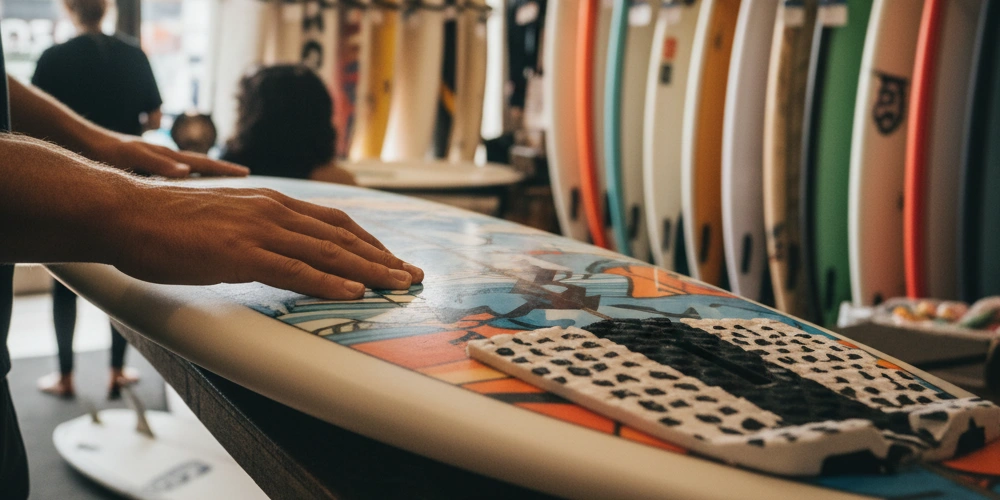
Right, so you’ve done a few lessons, you’re hooked, and now you want your own board. Good on you. But walking into a surf shop or browsing online and seeing hundreds of different boards in different shapes, sizes, and prices? That’s overwhelming.
Here’s the thing: your first board matters. Get it right and you’ll progress quickly, catch plenty of waves, and build your skills. Get it wrong and you’ll struggle, get frustrated, and maybe even give up on surfing altogether.
So let’s break down exactly what you need to know to buy your first surfboard in Australia without wasting money or making the classic mistakes that hold beginners back.
The Number One Mistake Beginners Make
Let’s start with what NOT to do, because this mistake is so common it needs to be addressed up front.
Do not – repeat, DO NOT – buy a small, thin, low-volume board just because it looks cool or because you saw your favorite pro surfer riding something similar.
That 5’10” shortboard with the thruster setup and the sick graphics? It’s not for you. Not yet. Maybe in a year or two, but not now.
Why? Because small boards are hard to paddle, unstable, and require significant skill to catch waves. You’ll spend all your energy paddling and missing waves, you won’t catch enough waves to improve, and you’ll get frustrated.
Every good surfer you see on a shortboard learned on something bigger. Every single one. They put in the time on boards with volume, built their skills, and then downsized gradually.
Start on a board that’s too small and you’re making surfing way harder than it needs to be.
Volume: The Magic Number
Volume, measured in liters, is the most important factor when choosing a beginner board. It determines how much the board floats, how easy it is to paddle, and how stable it feels under your feet.
More volume = easier to surf. Simple as that.
As a rough guide for absolute beginners:
- 50-60kg (110-130lbs): Look for 45-55 liters
- 60-75kg (130-165lbs): Look for 55-70 liters
- 75-90kg (165-200lbs): Look for 70-85 liters
- 90kg+ (200lbs+): Look for 85+ liters
These are just guidelines. Factors like fitness, age, and how athletic you are also matter. When in doubt, go bigger. You can always downsize later, but you can’t add volume to a board that’s too small.
Most beginner boards will have the volume listed either on the board itself or in the specs. If it doesn’t, ask. If the shop can’t tell you the volume, shop somewhere else.
Board Types for Beginners
There are a few different types of boards that work for learning. Each has pros and cons.
Soft Top / Foam Boards
These are the absolute best place to start for most people. Made with a foam core and soft exterior, they’re safe, stable, and forgiving.
Pros:
- Safest option – soft exterior means less injury when you inevitably hit yourself with the board
- Very buoyant and stable
- Durable – can take a beating
- Generally cheaper than fiberglass boards
- Great for building confidence
Cons:
- Not as responsive for turns
- Can feel sluggish compared to fiberglass
- Some people feel they’re “not real surfboards” (ignore this – they’re perfect for learning)
Brands like Catch Surf, Softech, and Gnaraloo make excellent soft tops. Even pros ride them for fun. There’s zero shame in learning on a foamie – it’s the smart choice.
Mini Mals (Mini Malibu)
These are scaled-down versions of traditional longboards, usually 7-8 feet. They’re typically fiberglass or epoxy construction.
Pros:
- More responsive than soft tops for turning
- Good middle ground between stability and performance
- Easier to transport than full longboards
- Look more like “traditional” surfboards
Cons:
- Harder surface means more risk of injury
- More prone to dings and damage
- Usually more expensive than soft tops
- Require more care
Longboards
Full-length longboards (9+ feet) are incredibly stable and easy to catch waves on.
Pros:
- Maximum stability
- Catch waves super easily
- Can ride them forever – plenty of experienced surfers love longboards
- Classic style
Cons:
- Heavy and cumbersome to carry
- Hard to maneuver and turn as a beginner
- Difficult to transport (might not fit in your car)
- More expensive
For most beginners, a 7-8 foot soft top or mini mal hits the sweet spot between performance and ease of use.
Understanding Dimensions
Beyond volume, boards have three key measurements:
Length: Measured in feet and inches. Longer boards are more stable and catch waves easier. For beginners, 7-9 feet is the range you’re looking at.
Width: Measured at the board’s widest point. Wider boards are more stable but slower to turn. Beginners want width – around 21-23 inches is good.
Thickness: How thick the board is at its thickest point. More thickness equals more buoyancy. Don’t go below 2.5 inches as a beginner; 2.75-3+ inches is better.
These dimensions are usually written on the board like this: 7’6″ x 22″ x 2.75″ (that’s length x width x thickness).
Fin Setups
Most beginner boards come with one of these fin configurations:
Single fin: Traditional setup, offers smooth, flowing turns. Great for cruising but not super maneuverable.
Twin fin: Two fins, looser and more skatey feel. Fun but maybe not ideal for absolute beginners.
Thruster (three fins): Most common setup, good all-around performance. Stable enough for beginners, responsive enough to grow into.
Quad (four fins): Fast and loose, probably not necessary for beginners.
For your first board, thruster or single fin are the way to go. Don’t overthink it – the fin setup matters way less than volume and dimensions at this stage.
New vs. Used: What’s Worth It?
New boards:
- No damage or wear
- Warranty (usually)
- Latest technology and materials
- You know exactly what you’re getting
Used boards:
- Much cheaper (potentially half price or less)
- More dings and wear
- No warranty
- Might need repairs
For a first board, used can be a great option if you find something in good condition. Check Gumtree, Facebook Marketplace, or local surf shop notice boards.
When buying used, look for:
- No major cracks or deep dings
- Minimal water damage (the foam inside shouldn’t be waterlogged)
- Fins in good condition
- No major delamination (where the fiberglass separates from the foam)
Small cosmetic dings are fine. Waterlogged boards or major structural damage are not worth it even if they’re cheap.
Budget: What Should You Spend?
In Australia in 2025, expect to pay:
New soft tops: $300-600 New mini mals (fiberglass/epoxy): $500-900 Used boards: $150-400, depending on condition
Don’t cheap out too much. Those $99 special from the big box stores? They’re usually terrible quality – heavy, poorly made, and won’t last. Spend a bit more to get something decent that’ll actually help you learn.
That said, you also don’t need to drop $1000 on your first board. Mid-range is perfect.
Consider it an investment. A good beginner board will last you a year or more, during which you’ll be surfing regularly and improving. Break that cost down per session and it’s pretty reasonable.
Where to Buy
Local surf shops: Best option. Staff can give advice, you can see and touch boards, and you’re supporting local business. Plus, they’ll usually throw in some wax or a leg rope.
Online surf retailers: Wider selection, often better prices, but you can’t physically check the board. Boardcave Australia has solid beginner guides and a good range.
Big box stores: Hit or miss. Sometimes have decent beginner boards, but staff usually don’t know much about surfing.
Direct from shaper: If you know what you want and can talk to a shaper about your needs, a custom board is amazing. Probably not necessary for a first board though.
Second-hand platforms: Gumtree, Facebook Marketplace, surf shop noticeboards. Great for deals, but you need to know what to look for.
Essential Extras You’ll Need
Buying the board is just the start. You’ll also need:
Leg rope/leash: Attaches your board to your ankle. Absolutely essential. Get one that’s roughly the same length as your board. Budget $30-50.
Wax: Provides grip on the deck. You’ll need different wax for different water temperatures. Budget $5-10 per bar, and you’ll go through several over time.
Fins: Some boards come with fins, others don’t. If you need to buy them separately, budget $30-80 for a basic set.
Board bag (optional but recommended): Protects your board during transport and storage. Soft bags are $50-100, hard cases are $150+.
Roof racks (if needed): If you’re driving to the beach, you’ll need a way to transport your board. Soft racks are $50-100, proper roof racks are $200+.
Factor these costs in when budgeting for your first setup.
The Progression Plan
Here’s the typical progression most surfers follow:
Stage 1 (Months 1-6): Soft top or large mini mal. Focus on catching whitewater, popping up, riding straight.
Stage 2 (Months 6-12): Same board, but now you’re catching unbroken waves, learning to angle your takeoff, attempting basic turns.
Stage 3 (Year 1-2): Transition to a smaller mini mal or funboard. More responsive, shorter length, starting to really turn and carve.
Stage 4 (Year 2+): Move to a proper shortboard if that’s your goal, or stick with funboards/longboards if that’s your style.
Don’t rush this progression. You’ll surf better faster if you take your time and master each stage.
Common Questions Answered
“Can I learn on a shortboard?”
Technically yes, realistically no. You’ll struggle so much that you’ll probably give up. Just don’t.
“What if people make fun of my beginner board?”
Anyone who makes fun of someone learning is a kook. Real surfers respect anyone putting in the effort. And honestly, nobody cares what board you’re on as much as you think they do.
“Should I get a custom board?”
Not for your first board. Get something off the rack or second-hand, learn the basics, then consider a custom board down the track when you know what works for you.
“What about those inflatable boards?”
They exist, but they’re not great for actual surfing. Stick with traditional construction.
“Can I just keep borrowing or renting?”
You can, but having your own board means you can surf whenever you want, you’ll build familiarity with how it rides, and over time it’s cheaper than renting.
Avoiding the Classic Traps
Let’s recap the mistakes beginners make:
Going too small: We covered this, but it bears repeating. Bigger is better when you’re learning.
Buying based on looks: That board might look sick, but does it suit your skill level? Function over fashion.
Not considering your local waves: If you surf mostly small beach breaks, you don’t need a gun for big waves. Choose a board for the conditions you actually surf.
Neglecting maintenance: Boards need care. Rinse them after sessions, repair dings promptly, store them properly.
Upgrading too fast: Master your current board before moving to something smaller or more performance-oriented.
The Test: Are You Ready to Progress?
How do you know when you’re ready to move from your beginner board to something smaller? Ask yourself:
- Can I consistently catch unbroken green waves?
- Can I paddle out through whitewater without getting worked?
- Can I angle my takeoff left or right?
- Can I make basic turns down the line?
- Do I feel comfortable and confident on my current board?
If you answered yes to all of these, you might be ready for something more performance-oriented. If not, stick with your current board and keep building skills.
Making the Purchase
When you’re ready to buy:
- Determine your budget – both for the board and essential accessories
- Research models – read reviews, watch videos, understand what’s out there
- Visit shops – see boards in person, talk to staff, get sized up properly
- Check second-hand options – you might find a great deal
- Make the purchase – pull the trigger on something suitable
- Get the accessories – leash, wax, fins if needed
- Hit the water – finally, get out there and surf!
Don’t overthink it. There’s no “perfect” first board. Any board in the right size range with decent quality will work. The best board is the one that gets you in the water more often.
Final Thoughts
Your first surfboard is exciting. It’s a commitment to the sport, a physical representation of your decision to become a surfer. That’s cool.
But remember: the board is just a tool. What matters is the time you put in, the waves you catch, the mistakes you make and learn from, and the stoke you get from progression.
Start on something that makes learning easier, not harder. Build your skills on a forgiving board. Master the fundamentals. Then downsize gradually as your ability improves.
Do it right and that first board will be the foundation of a lifetime of surfing. Rush it and you’ll just make things harder on yourself.
Now get out there and choose something good. The waves are waiting.